
Ableism is a network of systemic beliefs and practices that marginalize and discriminate against people with disabilities, while privileging those without them. It positions the able body and mind as the social, economic, and cultural norm, casting disability as something negative, inferior, and in need of fixing, curing, or eliminating.
Ableist attitudes are rooted in a binary opposition between “able” and “disabled,” with value measured against the standard of a healthy, able, and trained body. These beliefs are often reinforced through stereotypes, media representations, school textbooks, and the continued use of outdated and stigmatising language, such as “cripple,” “invalid,” or “handicapped.”
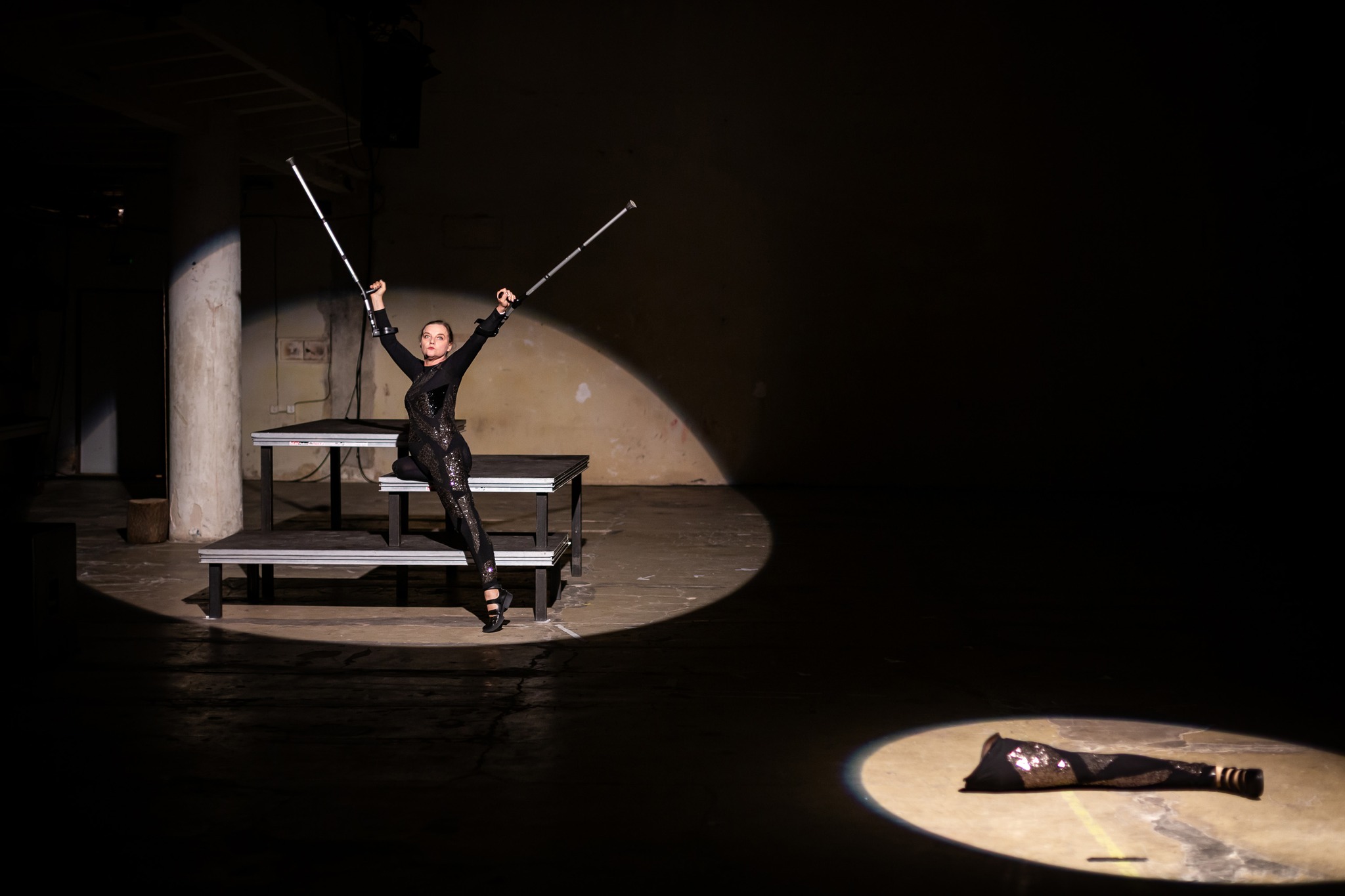
In her performance I’m Different, I’m Able, Joanna Pawlik addresses the experience of ableist exclusion she encounters daily when navigating public space. Drawing on her many years of living with a physical disability and her artistic practice in visual art and performance, the artist creates a distinctive choreography that highlights the performativity of the disabled body.
///
𝐉𝐨𝐚𝐧𝐧𝐚 𝐏𝐚𝐰𝐥𝐢𝐤
She lives and works in Kraków, where she works across performance, painting, drawing, photography, and video.
She graduated from the Faculty of Painting at the Academy of Fine Arts in Kraków, and in 2018 obtained a PhD in fine arts from the Faculty of Art at the University of the National Education Commission in Kraków.
Pawlik’s work navigates the intersection of social mechanisms of exclusion and intimate, personal spaces of perception. In her highly critical pieces – such as the video Balans (Balance) and the performance series Schody (Stairs) – she tests the limits of her own body, probes the notion of social norms, and frequently addresses disability in a provocative, subversive manner.
Through her artistic practice, she confronts enduring taboos around the bodies and sexuality of people with disabilities, or those who deviate from dominant standards of normativity.
She collaborates with leading contemporary art institutions in Poland, including the Zachęta National Gallery of Art in Warsaw, the Museum of Modern Art in Warsaw, the Museum of Contemporary Art in Kraków MOCAK, Wrocław Contemporary Museum, Bunkier Sztuki Gallery in Kraków, the Kronika Center for Contemporary Art in Bytom, the Arsenał Municipal Gallery in Poznań, and the Zamek Culture Center in Poznań.
Leave a Reply