
25 June 2025, 6 p.m.
Divadlo X10
Charvátova 10/39, 110 00 Prague 1, Czech Republic
𝐌𝐨𝐝𝐞𝐫𝐚𝐭𝐨𝐫: Piotr Sikora
𝐏𝐚𝐫𝐭𝐢𝐜𝐢𝐩𝐚𝐧𝐭𝐬: Agnieszka Chodysz-Foryś, David Helan, Katarzyna Lewandowska, Darja Lukjanenko, Elia Moretti, Eliza Trefas
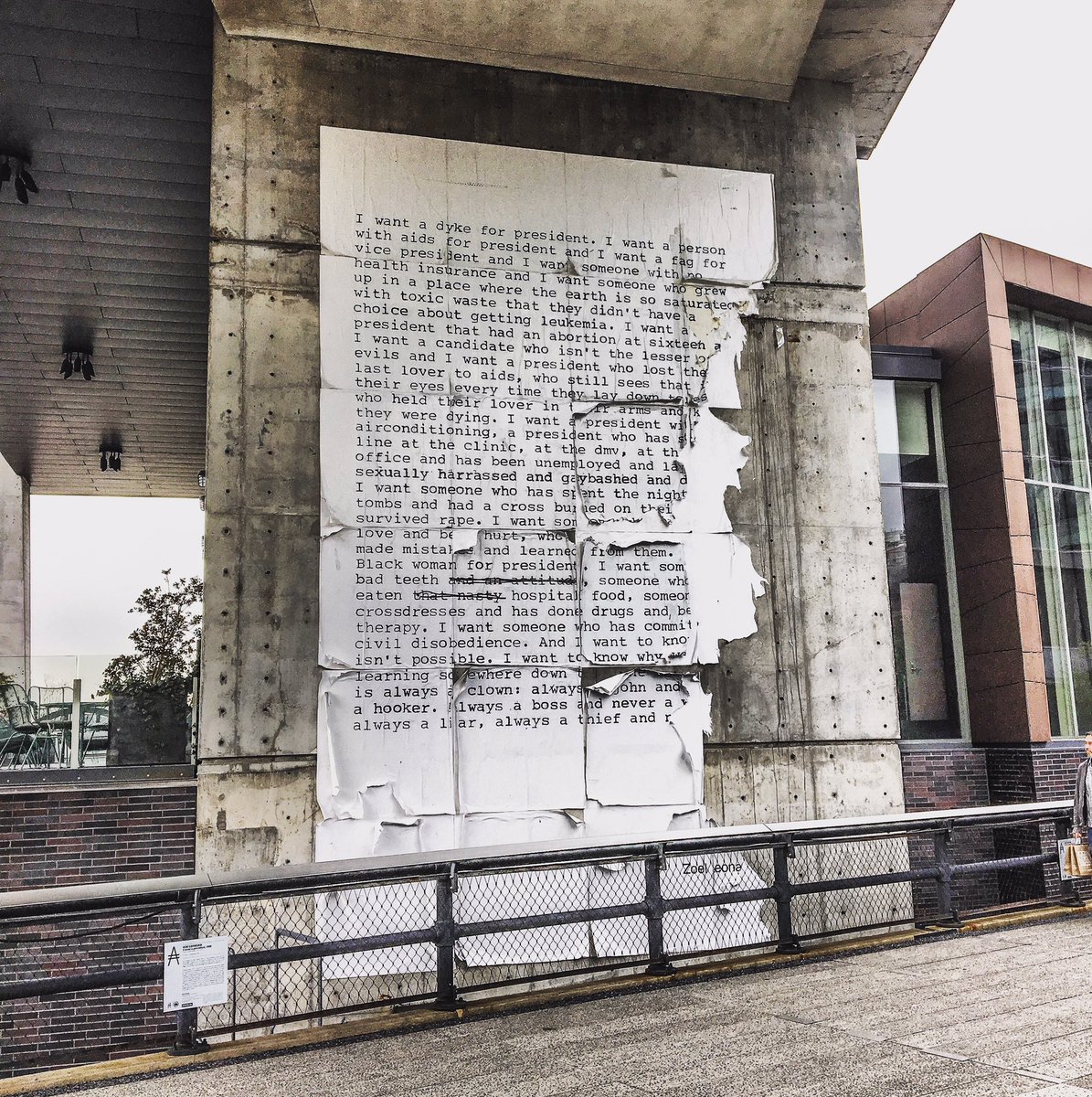
I want a dyke for president. I want a person with AIDS for president and I want a fag for vice president and I want someone with no health insurance and I want someone who grew up in a place where the earth is so saturated with toxic waste that they didn’t have a choice about getting leukemia. I want a president that had an abortion at sixteen and I want a candidate who isn’t the lesser of two evils and I want a president who lost their last lover to AIDS, who still sees that in their eyes every time they lay down to rest, who held their lover in their arms and knew they were dying.
I Want a President is a well-known text (1992) and installation (2016) by Zoe Leonard, which, since the early 1990s – after the end of the Cold War – has served as an important voice in American political and social discourse, a manifesto for those excluded from mainstream politics. It was inspired by and dedicated to Eileen Myles – “a woman, lesbian, poet and performer from New York’s East Village, a neighborhood of avant-garde, queer, poor artists.” In 1992 Myles ran a symbolic presidential campaign as an “openly female” candidate. It was an act of protest against George H.W. Bush’s claim that people who express themselves in a “politically correct” manner, including activists and minorities, are a threat to freedom of speech. Myles chose to respond to this provocation by presenting an alternative – an authentic, emotionally charged political strategy.
An equally significant example of art that uses language as a weapon is the practice of Barbara Hammer, who worked at the intersection of film and queer dialogue, exploring issues of exclusion based on sexual and gender identity. Her films often challenge the language of oppression directed at the LGBTQ+ community, showing how it can marginalize and exclude through stereotypes and the imposed invisibility of excluded groups. Hammer emphasized the role language plays in perpetuating prejudice and social isolation.
The Zachęta – National Gallery of Art in Warsaw is currently hosting an exhibition titled Andrea Fraser. Art Must Hang. Fraser is another artist associated with art criticism and performance, who has consistently practiced “cultural resistance” for years. She analyzes how the language of art institutions and their narratives can exclude those outside the mainstream, creating invisible social barriers. Her works demonstrate that the language used in art and culture can serve as a tool of oppression, reinforcing hierarchies and marginalizing social groups. Fraser critiques the way institutional language maintains the status quo, suppressing dissenting voices and excluding those who do not conform to the dominant narrative.
One of the performances in the (Non-)Presence Festival of Polish Performance program is Tomasz Opania’s Lentil, Wheel, Grinds, Mill. The title of the performance refers to one of the first Polish “shibboleths” and is inspired by Doris Salcedo’s Shibboleth, presented at Tate Modern in 2007. Opania constructs an intimate narrative based on the history of his own family, who experienced the stigma of these cruel keywords that separate “us” from “them.” Salcedo’s installation – a symbolic tear, scratch, or scar – speaks to trauma and violence, the invisibility of victims, and social marginalization. Her works uncover a hidden part of history excluded from official narratives, showing that language and symbolism can be used to obscure painful truths and sustain silence. Salcedo clearly illustrates how the language of oppression conceals the realities of suffering, making them invisible to the public.
Jenny Holzer’s eponymous work Protect Me from What I Want functions as a keyword, a message directed at those outside museums, galleries, and circles traditionally considered part of the art world. The artist has created nearly 300 such statements, based on common sayings and clichés, expressing a variety of perspectives. Some of them appeared in her first major text-based work, Truisms, which explores the concept of collecting and presenting information as art. Holzer has presented her slogans as large-format illuminated advertisements, stone benches, and car commercials. Her works are almost always political in nature, prompting reflection on our roles in society and the division between public and private spheres. Through her selection of quotations and their unadorned presentation, Holzer maintains a distance from personal expression. She does not speak in her own voice – it is a collective voice, a polyphony that belongs to all of us.
In a discussion bringing together experiences from various sectors of the Polish and Czech art scenes, we will examine the language of performance as a tool of both representation and resistance. Language – understood broadly, as gesture, body, voice, or narrative – can be used for communication, but also for exclusion. While reinforcing norms and structures of power, it also has the potential to dismantle them. During the panel, we will consider how performative practices expose invisible mechanisms of oppression and how they can open up space for voices that have so far been marginalized.
Agnieszka Chodysz-Foryś
______________________________
Piotr Sikora is a contemporary art critic and curator. His curatorial practice draws on inspirations as diverse as sauna culture, fried cheese, mycology, and kitsch. He co-hosts the gastro-artistic reality show GASTROFAZA, is the father of two sons, and nurtures a passion for cycling.
______________________________
Agnieszka Chodysz-Foryś is a curator and editor of publications on Polish contemporary art. For many years, she has developed a programme dedicated to the art of Wrocław, aiming to systematise and contextualise the practices and concepts of artists whose work has not yet been thoroughly studied – both in relation to their peers within the Wrocław milieu and in the broader context of European and global art. She initiated and co-edited monographs on figures such as Stanisław Dróżdż, Wacław Szpakowski, Natalia LL, Zdzisław Jurkiewicz, Jerzy Rosołowicz, and Maria Michałowska.
Her curatorial projects have been presented in Poland and internationally, including: the Polish performance art festival (nie)Obecność / (Non)Presence; the exhibition Dis/Connections at Kuad Gallery in Istanbul, organised to mark the 600th anniversary of Polish–Turkish relations; Silence of Sounds at Wrocław Contemporary Museum; Joanna Pawlik feat. Kamil Kurzawa, Daniel Stachowski. Air-Raid Shelter at the same institution; Andrzej Tobis: A–Z at FOTOGEN Gallery; Temporally-Spatially (FROM–TO), a presentation of works by Stanisław Dróżdż; and Equilibrium, featuring Marina Abramović, Janusz Bałdyga, Diana Lelonek, and Zhanna Gladko.
Since 2016, she has served as Head of the Visual Arts Department at the Culture and Art Centre in Wrocław. She is currently co-editing, together with Piotr Lisowski, the monograph Wrocław performatywny 1957–1989 [Performative Wrocław 1957–1989], and working on a monographic publication on Janusz Bałdyga (editor: Marta Smolińska), as well as an exhibition of Barbara Kozłowska’s work in Ljubljana (curator: Marika Kuźmicz).
______________________________
Czech artist David Helán, born in 1979 in Brno. He studied at the Academy of Fine Arts in Prague, and completed study stays at the prestigious Cooper Union in New York and Middlesex University in London, among others. His portfolio includes independent projects and exhibitions in the Czech Republic, but also in a number of foreign institutions and galleries. David Helán’s artistic personality synthesizes two different influences in an original way, artistic performance and cabaret entertainment. His live events, which always result in careful video or photographic documentation, move on the border of absurd theater with an overlap with purely contemporary themes and also serious questions. He creates a specific aesthetic atmosphere of comedy, melancholy and existential poetics imbued with material objects and symbols of everyday life, which serve him as quite practical tools in a given situation. Helán’s statement is imbued with creative lightness and playful imagination always underlines things that are essentially serious. His work is far from being limited to art institutions, but he is open to interaction and improvisation with any environment and audience. A civil level of humanity and at the same time conscious work with a serious artistic identity are a very fresh combination, which is rather rare in the art world today.
Text: Radim Langer
______________________________
Dr Katarzyna Lewandowska is an art historian, feminist, curator, activist, anarchist, and advocate for the rights of excluded and non-human persons. Her research focuses on corporeality in contemporary art, approached through an intersectional feminist lens. She is particularly interested in engaged and total art that critically confronts structures of power. Her work also explores representations of femininity in Tibetan art. She is the author of numerous exhibitions and curatorial series, and has collaborated with institutions including Galeria Wozownia, Galeria S, Spółdzielnia Socjalna Kulturhauz, the Centre for Contemporary Art in Toruń, and the Wyspa Progress Foundation in Gdańsk. She is a co-founder of the magazines Splesz and Death of the Patriarchy. Manifestos. The Revolution is Now.
Lewandowska graduated from the Faculty of Fine Arts at Nicolaus Copernicus University in Toruń, where she defended her MA thesis Iconography of the Buddhist Painted Scrolls from the National Museum in Warsaw, awarded the Jerzy Remer Prize. In 2009, she earned her PhD with the dissertation Women in Vajrayana Buddhist Painting: Iconography and Stylistic Evolution of Tibetan Painted Scrolls. In 1999–2000, she resided at the Buddhist Centre in Bristol, England, and in 2003, she received a scholarship from the Mongolian Academy of Sciences. She has worked at the Department of Art History and Culture and in the Gender Studies programme at the Institute of Philosophy, both at Nicolaus Copernicus University. She is currently affiliated with the Academy of Fine Arts in Gdańsk.
Since this year, she has served on the editorial board of the international academic journal Feminist Art Practices and Research: COSMOS, founded by Basia Śliwińska.
______________________________
Darja Lukjanenko comes from Dnipro, Ukraine. Based in Prague since 2017 she works interdisciplinary, across performance, text, and gardening. Her process is based on empathy stimulation practices and study of domination-free forms of relationships. Since 2020 she is confronting rockets and protesting cosmism. She graduated from UMPRUM and continues her education as a PhD student at Faculty of Art and Design at Jan Evangelista Purkyně University in Ústí nad Labem. Her research concerns Postcolonial Identity and Cultural Practices for the Collective Memory Reconstruction in Ukraine after 2014. Her works were exhibited in the Czech Republic, Ukraine, USA, Sweden, Greece, Poland and other countries. In 2025 she became a part of the Secondary Archive.
______________________________
Elia Morreti (born 19 June 1986 in Milan, Italy) is a composer, performer and researcher who explores the performativity of sound and listening as critical tools within contemporary music theatre. After training in percussion at the Nicolini Academy of Music in Piacenza and studying social sciences at the University of Pavia, he now works across disciplines at the intersection of sound, performance and social practice. He is currently completing a PhD at Charles University in Prague, where his research focuses on how artistic practices emerge from and respond to contexts, with a particular emphasis on the role of sound in multimodal discourse. He co-founded the performance group Ferst Dadler, developing collaborative formats that activate public spaces through sound and participatory dramaturgy. His works include the award-winning radio play Once Enea Stuck an Apple Seed in My Ear and the site-specific project Republika Zahradníiíiíiíiíi. Elia has taught at institutions across Europe, focusing on listening as a relational, performative, and potentially resistant act.
______________________________
Eliza Trefas (1998, Romania) works in dance, performance, and visual arts. She is interested in forming practices and performances that bridge visible and invisible forms of life through the body. She attempts to fix ills through poetic perspectives and open states of embodied poetry. She is currently an artist in residence at Meet Factory where she works around (her) eating disorder to make an exit practice and shift physical and mental hunger towards more esthetic, poetic, art hunger.
She is co-hosting Somn (Sleep) in Bucharest with Florin Flueras, an art space for deep and relaxed departures, for falling asleep to rigid institutional conventions and expectations. Her works were presented in contexts such as Salonul de Proiecte, Suprainfinit Gallery, eXplore Festival, National Dance Centre Bucharest, Multiplicidades Festival Santa Cruz, RAKETE Tanzquartier Vienna, DO Festival Gdansk. In 2021 she received the CNDB prize for her contribution in contemporary dance.